
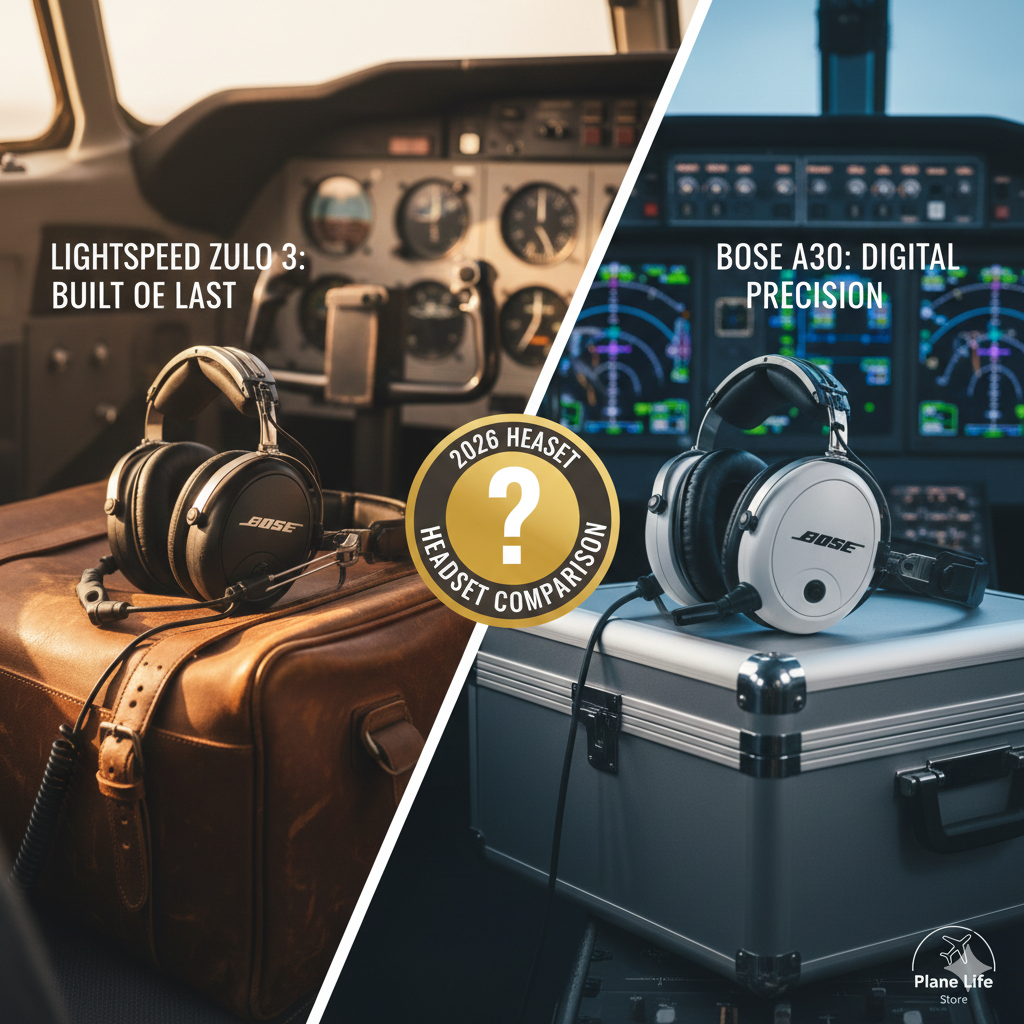
Let’s be honest: choosing a high-end aviation headset feels a lot like choosing a flight school or your first solo aircraft. It’s an investment in your safety, your hearing, and perhaps most importantly on those four-hour cross-country legs your sanity.
If you’ve spent any time in a hangar lately, you’ve heard the debate. It usually pits the “Bose loyalists” against the “Lightspeed enthusiasts.” With the 2023 release of the Bose A30 and the continued dominance of the Zulu 3 ANR Headset, the conversation has only intensified as we head into 2026.
I’ve spent hundreds of hours under various ear seals, and I can tell you that the “best” headset isn’t always the most expensive one. It’s the one that doesn’t give you a “hot spot” headache at 8,000 feet. Today, we’re breaking down the Lightspeed Zulu 3 and the Bose A30 to see which one deserves a spot in your flight bag this year.
Before we dive into the decibels, it’s important to understand what these two brands stand for.
Bose is the undisputed giant of Active Noise Reduction (ANR). They practically invented the category, and the A30 is their refined, digital masterpiece. It’s sleek, it’s TSO-certified for the pros, and it carries that premium “Bose” cachet.
Lightspeed, on the other hand, often feels like the “pilot’s pilot” company. Based in Oregon, they’ve built a cult following by focusing on ruggedness, long-term value, and an industry-leading 7-year warranty that makes Bose’s 5-year plan look a bit stingy.
| Feature | Lightspeed Zulu 3 | Bose A30 |
| ANR Type | Advanced Analog/Digital Hybrid | Fully Digital (3 Modes) |
| Weight on Head | ~14.6 oz | ~14.2 oz |
| Warranty | 7 Years | 5 Years |
| Certification | Standard Aviation | FAA TSO / EASA Certified |
| Typical Price | ~$899 – $949 | ~$1,299 |
If a headset is uncomfortable, nothing else matters. You could have the quietest cockpit in the world, but if your ears are throbbing after two hours, you’re going to be distracted.
The Bose A30 is widely considered the king of comfort, especially if you have a smaller head or are sensitive to clamping force. Bose managed to reduce the side pressure by 20% compared to the already-comfortable A20. When you put them on, they feel “barely there”.
The A30 uses a center-pivot spring design that distributes weight evenly across the top of your head. If you’re a commercial pilot flying 80 hours a month, that 20% reduction in squeeze is a massive deal.
Lightspeed takes a different approach. Their ear seals are arguably the best in the business they are large, plush, and “tapered” to follow the curve of your jaw. This creates a natural seal that is particularly great for pilots who wear thick-rimmed aviation sunglasses.
However, the Zulu 3 does have a slightly higher clamping force than the Bose. Some pilots (like me) actually prefer this because it feels more secure in a bouncy, turbulent cockpit. Others find it a bit too “snug” after a few hours.
The Verdict on Comfort: If you want the lightest touch possible, go Bose. If you wear glasses and want a “molded” fit, the Zulu 3 might actually feel better for you.
This is where the tech geeks get excited.
The Bose A30 introduced digital ANR with three selectable modes: High, Medium, and Low.
The Zulu 3 ANR Headset uses a very high-end hybrid system that many pilots claim is “spooky quiet”. While it doesn’t have the selectable digital modes of the Bose, it is exceptionally good at cancelling out that low-frequency engine rumble that causes the most fatigue.
In a side-by-side “blind” test, most pilots would struggle to tell the difference in raw quietness. Both are top-tier. However, the A30’s “tap control” for talk-through is a modern convenience that’s hard to ignore if you often fly with passengers not on the intercom.
Let’s talk about the “Bose Tax.” You’re paying about $350–$400 more for the A30 than the Zulu 3. Does that mean it’s more durable?
Actually, the opposite might be true.
The Bose aviation headset is a masterpiece of engineering, but it uses a fair amount of high-quality plastic and lightweight alloys to keep the weight down. It feels premium, but maybe a little delicate.
The Lightspeed Zulu 3, conversely, is built like a tank. It features a stainless steel headband, magnesium ear cups, and those famous Kevlar-core cables that are nearly impossible to kink or break.
When you pick up a Zulu 3, it feels solid. It’s the headset I’d trust most if I were a flight instructor tossing my gear into a different plane three times a day. And again, that 7-year warranty from Lightspeed is a huge trust signal—they expect this thing to last nearly a decade of daily abuse.
Both headsets come standard with Bluetooth for your phone or tablet. This is essential for 2026 pilots who rely on ForeFlight alerts or want to listen to a podcast during a long, quiet cruise.
Bose A30 Perks:
Lightspeed Zulu 3 Perks:
If you’re a professional pilot for a major airline or a Part 121 operator, your choice might be made for you.
The Bose A30 is TSO-certified (Technical Standard Order), which means it meets specific FAA performance and durability standards required by many commercial operators.
The Zulu 3 is NOT TSO-certified. For a general aviation pilot, this means absolutely nothing. But for a professional flying a 737, it’s often a requirement. (Note: If you want a TSO-certified Lightspeed, you’d have to look at their other models, but for the Zulu 3, it’s a no-go for most airline cockpits).
So, who wins the 2026 crown? It depends on your mission profile.
At the end of the day, both the Zulu 3 ANR Headset and the Bose aviation headset are fantastic pieces of technology. If you can, try them both on at your local pilot shop. Everyone’s head is shaped differently, and what feels like a dream to one pilot might feel like a vise to another.Ready to upgrade your cockpit experience? Whether you’re leaning toward the rugged reliability of Lightspeed or the digital finesse of Bose, don’t settle for “okay” audio. Check out our latest deals on the Lightspeed Zulu 3 and take the first step toward a quieter, more focused flight today.